



High school NIL (name, image, and likeness) is real money, and it is available to most athletes right now. As of 2026, 45 states and Washington, D.C., permit some form of high school NIL activity while Alabama, Hawaii, Wyoming, Mississippi and Indiana prohibit most if not all activity. One wrong move in a state with tight HS NIL rules can cost an athlete significant eligibility, in Ohio, for example, OHSAA can impose a penalty of up to 20% of the sport season for a late or missing disclosure filing.
This landscape is not governed by the NCAA. High school NIL regulations come from state athletic associations, and every state operates under its own framework. What is legal in Georgia may be an eligibility violation in Mississippi. What requires a 72-hour disclosure in Virginia may need a 14-day filing in Ohio. Families who treat high school NIL like a simple side hustle are the ones who end up sitting in their athletic director’s office explaining why they did not know the rules.
Understanding your state’s current stance is step one – along with staying up to date on ever-changing rules and regulations. Compliance, documentation, and brand readiness protect eligibility and make athletes attractive to legitimate sponsors. This guide covers the state-by-state breakdown, the compliance rules that apply almost everywhere, and the pre-deal steps every family needs to complete. Please note that these laws change frequently and are complex – you should consult your athletic department before agreeing to any NIL deals.
Key Takeaways
- High school NIL rules are state-specific: as of October 2026, 45 states plus D.C. permit activity.
- School branding, pay-for-play and recruiting inducements are broadly prohibited, even where high school NIL activity is otherwise allowed.
- Disclosure deadlines vary sharply by state, ranging from 72 hours in several states to 14 days.
- Minors generally need guardian involvement, a written contract and compliance with any required NIL education or state-association filing rules.
- NIL income remains taxable, and families should track every payment, product and expense while meeting separate athletic disclosure deadlines.
Can high school athletes get NIL deals?
Yes, high school athletes in some states can earn money through name, image and likeness (NIL) activities, including endorsements and sponsored content. Whether a particular deal is permitted depends on the applicable state law, high school athletic association rules and school policies. Athletes should confirm all requirements before accepting compensation. “The most important thing is to understand your state’s guidelines,” said Alec Snider, lead NIL educator at IMG Academy. “They all differ.”
Top high school student-athletes, where permitted, are signing deals with big companies – like Nike, which recently signed 12 high school football players to its NIL roster.
But deals vary. In North Carolina, one report found most high school NIL deals were worth between $200 and $700. Keep in mind, no matter the dollar amount, no deal is worth jeopardizing your future eligibility or earnings – it’s important to consult with an NIL expert if you have any questions. It’s also important to vet any NIL agents or anyone involved in the deal. Coaches warn that high school athletes, in the new world of NIL, are at risk of being exploited by unscrupulous actors like agents charging fees far above what should be the norm.
It’s important to protect yourself when entering into any NIL deals. And part of that means knowing and keeping up to date on high school NIL requirements.
Where to check high school NIL requirements
- Your state high school athletic association and athletic director
- Applicable state laws and school or district policies
- Any national or sport-specific governing-body rules
- College eligibility guidance if the athlete is being recruited
High school NIL: video explainer
Which states allow high school NIL in 2026 (and which ones don’t)
The clearest way to understand the current map is to break it into three categories: outright prohibited, heavily restricted, and generally permitted. Each category carries different risks, and athletes who proceed in the wrong category without checking may face eligibility consequences depending on the state association’s policy and enforcement discretion.
High school NIL rules: state-by-state directory
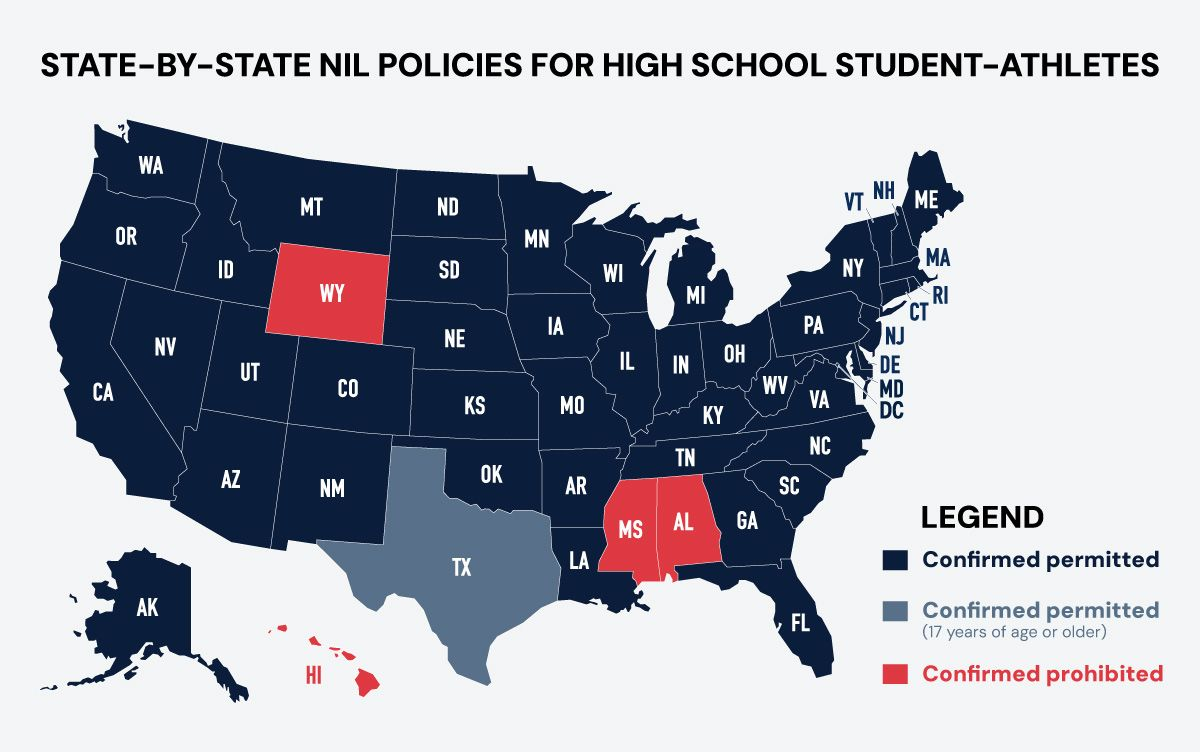
Below is access to state-by-state rules and regulations for each high school association.
| State | NIL Status | Athletic Association | Notes |
|---|---|---|---|
| Alabama | Outright prohibited | AHSAA | Athletic NIL compensation generally violates amateur-status rules. Latest bill failed in committee in 2026. |
| Alaska | Generally permitted | ASAA | — |
| Arizona | Generally permitted | AIA | Athletes or their parents must notify their athletic director within five school days of an NIL agreement. |
| Arkansas | Heavily restricted | AAA | Available to high school athletes who have signed a letter of intent or been accepted to an Arkansas college |
| California | Generally permitted | CIF | School logos, uniforms and recruiting-related compensation may be restricted. |
| Colorado | Generally permitted | CHSAA | — |
| Connecticut | Generally permitted | CIAC | — |
| Delaware | Generally permitted | DIAA | The 72-hour notification requirement applies to agency contracts, not all NIL endorsements. |
| District of Columbia | Generally permitted | DCSAA | — |
| Florida | Generally permitted | FHSAA | NIL permitted since the 2024–25 school year. |
| Georgia | Generally permitted | GHSA | NIL agreements must be disclosed within seven calendar days. |
| Hawaii | Outright prohibited | HHSAA | NIL compensation tied to the athlete’s sport can jeopardize eligibility. |
| Idaho | Generally permitted | IHSAA | — |
| Illinois | Generally permitted | IHSA | — |
| Indiana | Generally permitted | IHSAA | Personal Branding Activities permitted beginning with the 2026–27 school year. |
| Iowa | Generally permitted | IHSAA / IGHSAU | Rules may differ by governing association. |
| Kansas | Generally permitted | KSHSAA | Qualifying influencer and endorsement activities permitted under amateur-status restrictions. |
| Kentucky | Generally permitted | KHSAA | — |
| Louisiana | Generally permitted | LHSAA | — |
| Maine | Generally permitted | MPA | — |
| Maryland | Generally permitted | MPSSAA | — |
| Massachusetts | Generally permitted | MIAA | — |
| Michigan | Generally permitted | MHSAA | Updated NIL rules took effect in January 2026. |
| Minnesota | Generally permitted | MSHSL | — |
| Mississippi | Outright prohibited | MHSAA | The 2026–27 handbook expressly prohibits high school NIL contracts. |
| Missouri | Generally permitted | MSHSAA | NIL activities must not represent the school or involve performing athletic services. |
| Montana | Generally permitted | MHSA | The 2026–27 handbook permits qualifying NIL activities under By-law 16.2. |
| Nebraska† | Generally permitted | NSAA | — |
| Nevada | Generally permitted | NIAA | — |
| New Hampshire | Generally permitted | NHIAA | — |
| New Jersey | Generally permitted | NJSIAA | — |
| New Mexico | Generally permitted | NMAA | — |
| New York | Generally permitted | NYSPHSAA | — |
| North Carolina | Generally permitted | NCHSAA | Parent/guardian consent, NIL education and disclosure requirements may apply. |
| North Dakota | Generally permitted | NDHSAA | — |
| Ohio | Generally permitted | OHSAA | Agreements must be disclosed within 14 days. |
| Oklahoma | Generally permitted | OSSAA | — |
| Oregon | Generally permitted | OSAA | — |
| Pennsylvania | Generally permitted | PIAA | Review applicable disclosure and school-affiliation requirements. |
| Rhode Island | Generally permitted | RIIL | — |
| South Carolina | Heavily restricted (provisional) | SCHSL | The 2026–27 bylaws contain conflicting NIL language. Obtain clarification before signing. |
| South Dakota | Generally permitted | SDHSAA | NIL permitted beginning July 1, 2024. |
| Tennessee | Generally permitted | TSSAA | — |
| Texas | Heavily restricted | UIL | Athletes 17+ may sign certain college NIL agreements. Third-party deals generally must wait until UIL eligibility ends. |
| Utah | Generally permitted | UHSAA | — |
| Vermont | Generally permitted | VPA | — |
| Virginia | Generally permitted | VHSL | Review disclosure deadlines and prohibited endorsements. |
| Washington | Generally permitted | WIAA | — |
| West Virginia | Generally permitted | WVSSAC | — |
| Wisconsin | Generally permitted | WIAA | — |
| Wyoming | Outright prohibited | WHSAA | A 2026 law prohibits NIL compensation related to competing in the athlete’s sport, with limited exceptions. |
States where sport-related NIL compensation can jeopardize eligibility
Alabama, Hawaii, Mississippi and Wyoming have amateur-status restrictions that generally prevent active high school athletes from receiving compensation tied to the sport in which they compete.
Mississippi’s 2026-27 MHSAA handbook expressly states that the state does not allow NIL contracts for high school students.
Wyoming enacted W.S. 21-25-401, effective July 1, 2026, which provides that compensation tied to competing in a sport can forfeit amateur status in that sport.
Alabama’s AHSAA retains a restrictive amateur rule. These are athletic eligibility rules; avoid describing every form of ordinary nonathletic earnings as unlawful.
States where NIL monetization is off-limits
Alabama, Hawaii, Montana, and Wyoming maintain amateur-status rules that treat NIL monetization as an eligibility violation.
Athletes in these states who sign any commercial NIL deal risk losing their eligibility, regardless of how modest the compensation is.
States with major restrictions tied to commitment or enrollment
Arkansas, Missouri, and Texas technically permit some NIL activity, but the conditions attached make the window very narrow.
Arkansas and Missouri tie eligibility to factors like signing a letter of intent to an in-state college.
Texas’s HB 126, which took effect June 5, 2025, created an exception for athletes age 17 and older to sign NIL contracts, but it did not broadly authorize UIL athletes to monetize NIL while in season.
States where high school NIL is generally permitted
The majority of states now allow high school athletes to earn NIL income without forfeiting eligibility, provided they follow the association’s guidelines. Recent additions to this group include Michigan (January 2026), Indiana (2026-27 school year under its Personal Branding Activity framework), Ohio (emergency referendum, November 2025), and Florida (2024-25 school year).
“Permitted” does not mean unrestricted. Every state in this category still attaches eligibility conditions, state NIL laws for high school athletes vary considerably from one association to the next, so direct verification remains essential.
The compliance rules nearly every state agrees on
Even in states that permit high school NIL, a consistent set of restrictions applies almost everywhere. Athletes and parents who understand these universal lines will avoid the most common eligibility traps, regardless of their specific state’s rules.
Pay-for-play and school affiliation are the clearest lines
Most associations prohibit compensation contingent on wins, statistics or specific athletic performance. They also restrict use of school names, logos, mascots, uniforms, facilities and involvement by school representatives. Policies vary in their precise scope and exceptions; review the specific rule for the athlete’s state and sport.
No recruiting inducements, prohibited product categories, and required disclosure
NIL payments generally must not be used as inducements to enroll in, stay at or transfer to a school. Many state associations restrict endorsements of alcohol, tobacco or nicotine, gambling, controlled substances or other age-inappropriate products. Deal-specific review matters: a sponsor’s industry, proposed content and school affiliation can affect eligibility.
Disclosure is a separate compliance requirement in many, but not all, states. Some examples:
- Ohio’s OHSAA requires reporting within 14 days of an NIL agreement and provides penalties for late or missing reports.
- Georgia’s GHSA requires disclosure to the principal or athletic director within seven calendar days.
- Arizona’s AIA requires notice to the athletic director within five school days.
- In Delaware, the 72-hour notice in DIAA Regulation 1030, section 3.4.5, applies to an agency contract (not every NIL endorsement).
It’s important to check with the rules and regulations in your state and school district before moving forward on an NIL agreement in high school.
Key rule changes from 2024 to 2026 that reframed the conversation
The high school NIL landscape shifted significantly in a 24-month window. The rules in place today look different from what was on the books two years ago, which is exactly why searching for NIL endorsement guidance for high school athletes can return conflicting information depending on when a source was written.
States that moved from prohibition to permission
Several associations adopted or broadened NIL permission during 2024-26. These include:
- Florida permitted NIL beginning with the 2024-25 school year.
- Ohio approved NIL in November 2025 after litigation over its previous ban.
- Michigan updated its rule in January 2026, and Indiana adopted its Personal Branding Activity framework for the 2026-27 school year.
- Montana’s 2026-27 rulebook also authorizes NIL under defined conditions.
- Wyoming took a different direction by enacting a sport-related amateur-status law effective July 1, 2026.
What athletes and parents must complete before signing any deal
This is where families most often make mistakes. Understanding that NIL is allowed in your state or the state where a student-athlete competes is not the same as being ready to sign a deal. Specific steps must happen first, and skipping any of them creates real eligibility risk.
Guardian consent, the NFHS NIL course, and the written contract
Minors generally cannot sign NIL contracts alone. A parent or legal guardian must co-sign or be listed as a party to the agreement.
In North Carolina, both the athlete and the guardian must complete the NFHS Name, Image and Likeness course before the deal is signed, along with submitting a compliance certification and the signed agreement to school and district officials.
Florida’s FHSAA, by contrast, recommends the course but does not require it. Know what your state mandates, not just what it suggests.
The written contract itself must clearly identify the athlete, the brand, and the guardian. It should specify deliverables, payment amount, term, exclusivity, usage rights, and termination and dispute-resolution terms. A deal agreed to through text messages or a handshake creates a documentation gap that can surface as an eligibility complication during an association review. Use a written contract. Full stop.
Tax basics, financial records, and disclosure deadlines
NIL income is taxable, and that applies to minors. Payments for posts, appearances, and endorsements are generally treated as self-employment income. You should consult a tax professional for all questions specific to your NIL deals.
Disclosure deadlines to athletic associations are a separate obligation from tax filing, and the consequences for missing them are athletic, not financial. In Ohio, a late disclosure can result in sitting out up to 20% of the season. Know your state’s window before the deal closes, and document when you submitted the required materials.
Building your personal brand before NIL income arrives
Brand sponsors evaluate athletes much the way college coaches do, looking at visibility, track record, and professionalism. Before a brand approaches an athlete, or before an athlete approaches a brand, the foundation needs to be in place. An athlete with no digital presence, no documented credentials, and no professional profile is not an attractive NIL partner regardless of athletic ability.
Read more: Should athletes build a personal brand before recruiting?
Why your recruiting profile is also your NIL brand
Athletes already navigating the college recruiting process have a natural head start on NIL readiness. A complete, coach-facing recruiting profile that documents academic credentials, athletic stats, film, and accomplishments in a single professional format is exactly what a potential sponsor wants to see.
NCSA College Recruiting by IMG Academy helps athletes build that kind of polished profile, one that creates a credible digital presence for both college coaches and brand partners. Athletes who are prepared for the recruiting process tend to be the same athletes sponsors find most appealing.
NIL preparation resources worth knowing
IMG Academy has incorporated NIL readiness into its athlete development programming. IMG Academy provides structured NIL education for student-athletes in the boarding school program including entrepreneurship, getting started with NIL and more.
These resources exist because brand readiness is a developed skill, not a natural byproduct of athletic talent. Athletes who invest in that preparation are better equipped to pursue NIL activity compliantly and strategically when their state permits it and are better protected against the mistakes that cost eligibility.
View IMG Academy’s NIL Curriculum.
What to do right now before any deal gets discussed
High school NIL is available to many athletes in 2026, but the rules are state-specific, actively changing, and carry real eligibility consequences if ignored. The framework is straightforward: know your state’s current stance, follow the universal compliance rules that apply almost everywhere, and complete the required documentation before anything is signed.
For student-athletes looking for a strong foundation in NIL, Snider suggests finding partners that are a natural fit.
“Think about what your goals are. Do you want to make money? Give back to the community? Figure out what your passions and hobbies are. And then we create a roadmap from there,” he said. “It’s easier to succeed when you love something. That’s why we find the passions and the hobbies and stay within those sectors because the passion drives the work ethic.”
Rules can change mid-season, and association websites do not always reflect the most recent amendments. Checking directly with your school athletic director or your state’s athletic association is the only way to get current, binding guidance before engaging with any brand or agent.
Athletes who build their personal brand now, through a strong recruiting profile, visible athletic identity, and documented credentials, will be better positioned when NIL opportunities arrive. The recruiting process and NIL readiness are not separate tracks. They reinforce each other, and the athletes who treat them that way are the ones who end up with both the scholarship offer and the brand deal.
Start with a free recruiting profile.
Frequently asked questions
Which states allow high school athletes to earn NIL money?
Most states now allow some form of high school NIL activity, but rules vary significantly. As of October 2026, at least 45 states plus Washington, D.C. clearly permit high school athletes to earn NIL compensation, while states including Alabama, Hawaii, Mississippi and Wyoming continue to prohibit it. Arkansas and Texas have more limited exceptions. Athletes should always check their state athletic association’s current rules before signing a deal.
Can an NIL deal cost my athlete their high school eligibility?
Yes. An athlete can lose eligibility if an NIL deal violates state association rules, such as restrictions on pay-for-play, recruiting inducements, school logos or uniforms, or prohibited sponsors. Requirements vary by state, so families should review the applicable rules before accepting compensation.
Do parents have to sign NIL deals for minors?
Often, yes, but requirements vary by state. Some states specifically require a parent or guardian’s written consent for NIL contracts involving athletes under 18. Families should review both state law and high school athletic association rules before a minor signs an agreement.
