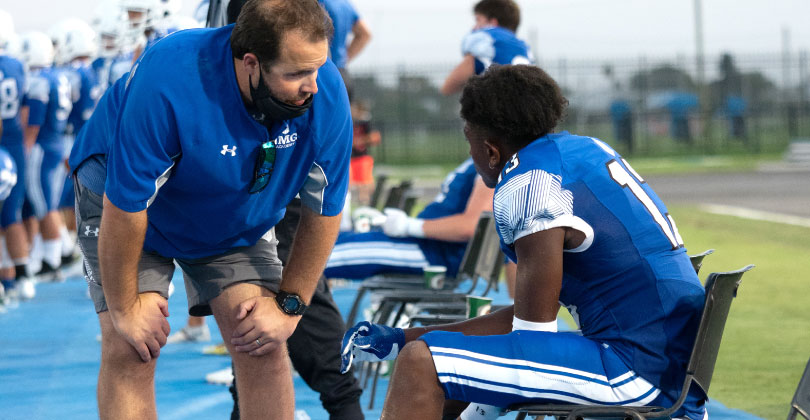
What is a Redshirt Freshman?
A redshirt freshman is a college athlete who sits out of official competition during their first year to preserve one of their four seasons of eligibility. They can still practice and receive scholarships, but their five-year NCAA eligibility clock continues to run.
If you’re research college athletics eligibility, you’ve likely heard the term redshirt. Understanding how redshirting works, and when it makes sense, can directly impact your playing time, scholarship status and long-term college career.
Below we break down eligibility rules, medical vs traditional redshirts, scholarship impact and when athletes should consider redshirting.
On This Page
What is a Redshirt?
In NCAA sports, a redshirt is an athlete who sits out of gameplay for a season while remaining eligible to compete in four years of college sports.
Starting in the 2026-2027 school year, Division I athletes are allowed:
- Five calendar years to complete
- Five seasons of competition
These updated rules may eliminate the benefits of redshirting at the Division 1 level.
When an athlete redshirts — now more likely only at the Division 2 and Division 3 levels, they use one academic year but do not use one of their four competition seasons. The following year, they are academically a sophomore but compete athletically as a freshman, hence the term redshirt freshman.
How NCAA Eligibility Works
To fully understand what a redshirt freshman is, you need to understand the NCAA’s eligibility clock.
The NCAA Five-Year Clock
In NCAA Division 1, athletes have five calendar years to compete in five seasons. This clock starts once a student enrolls full-time at a college or the academic year after a student-athlete’s 19th birthday.
For Division 2, athletes have 10 semesters (or 15 quarters) to complete four seasons.
Division 3 does not use a strict five-year clock but does limit participation to four seasons.
Redshirting allows athletes to stretch those four seasons across five academic years.
Types of Redshirts
There are two primary types of redshirts: traditional redshirts and medical redshirts.
Traditional (Normal) Redshirt
A traditional redshirt occurs when an athlete chooses — or is advised by their coach — not to compete during a season.
Reasons for a traditional redshirt may include:
- Physical development needs
- Adjusting to college academics
- Recovering from minor injuries
- Learning a new system or position
- High competition at their position
Athletes can still practice with the team and receive coaching instruction during a traditional redshirt year.
Medical Redshirt (Medical Hardship Waiver)
A medical redshirt (also called a medical hardship waiver) is granted when an athlete suffers a season-ending injury early in the year.
To qualify under current NCAA rules, the injury must:
- Occur in the first half of the season, and
- Limit the athlete to participation in no more than 30% of the team’s scheduled contests
If approved, the athlete retains that season of competition.
Medical redshirts are not automatic and require documentation and conference approval.
Medical Redshirt vs. Normal Redshirt: What’s the Difference?
| Feature | Traditional Redshirt | Medical Redshirt |
|---|---|---|
| Competition allowed? | No | Limited (under 30%) |
| Injury required? | No | Yes |
| Approval required? | No formal waiver | Yes, conference approval |
| Preserves season? | Yes | Yes |
Both options preserve a season of competition, but medical redshirts require documentation and official approval.
Eligibility Impact: How Redshirting Affects Your NCAA Career
Redshirting can significantly impact your eligibility timeline and long-term development.
Here’s how at the D2 and D3 levels:
- You preserve one of your four competition seasons.
- You gain an additional year to physically mature.
- You get more time to learn the system.
- You extend your time on campus (up to five years in Division I).
Many athletes who redshirt as freshmen go on to have four full competitive seasons as upperclassmen, sometimes graduating with both athletic experience and advanced academic credentials.
However, redshirting does not “pause” your eligibility clock. The five-year clock continues to run during your redshirt year.
When Should You Consider Redshirting?
Redshirting is a decision typically mad in collaboration with your coach.
You may consider redshirting if:
- You are behind physically compared to teammates.
- You are recovering from injury.
- You are unlikely to see playing time due to roster depth.
- You want to preserve a year for long-term development.
- You plan to pursue graduate school and want an additional year of competition.
In today’s college sports landscape, redshirting may not be as popular as it once was for first-year freshmen.
For athletes, it’s important to understand both the short-term sacrifice and the long-term benefit.
Read more: How to Overcome a Sports Injury During the Recruiting Process
Does Redshirting Affect Scholarships?
One of the most common concerns is whether redshirting impacts athletic scholarships.
The short answer: Usually, no. But now redshirting is likely to be eliminated at the D1 level.
In most cases:
- Redshirt athletes still receive their athletic scholarship.
- Coaches can renew scholarships annually.
- Redshirting does not automatically reduce or cancel aid.
However, scholarships are typically awarded on a one-year renewable basis. Coaches ultimately control renewal decisions, so communication is key.
It’s important to clarify scholarship terms with your coach and compliance office before making any redshirt decisions.
Pros and Cons of redshirting as a freshman
Pros
Two of the main pros of being a redshirt freshman are that student-athletes get a year to build up their athletic skills and focus on college classes.
Transitioning from high school to college can be an adjustment, so it might be good for a freshman student-athlete to redshirt to minimize feeling overwhelmed.
When a redshirt freshman has a better handle on college life and their athletic abilities in their sophomore year, they can focus their energy on competing.
Cons
A major con of being a redshirt freshman is that you won’t get to do everything their team does for a year, like play competitive games or travel.
Another con is that you must add more training to your schedule, as coaches often expect redshirt freshmen to show improvements from the time they take off to train or heal.
What Is a Redshirt Freshman in Other Associations?
NAIA
NAIA schools allow athletes to compete in four seasons within 10 semesters. Redshirting policies vary slightly but generally allow athletes to preserve seasons under similar principles.
Junior College (NJCAA)
Junior college athletes typically have two seasons of competition over two years. Redshirting policies differ by conference and situation.
Always confirm rules directly with your school’s compliance office.
Is Redshirting Right for You?
Understanding what a redshirt freshman is, and how redshirting affects eligibility, scholarships and development, is critical for long-term athletic success.
Redshirting can be a powerful tool for:
- Physical growth
- Skill development
- Academic adjustment
- Long-term career planning
However, every athlete’s situation is unique. Before making a decision, speak with your coach, compliance office and family to evaluate how redshirting fits into your overall college and athletic goals.
The more informed you are about eligibility rules, the better positioned you’ll be to make smart decisions that protect your future in college sports.
FAQs
Here are some common questions and answers about redshirts and redshirt freshmen.
What is a redshirt freshman in simple terms?
A redshirt freshman is a first-year college athlete who practices but does not compete in games, preserving one of their four seasons of eligibility while continuing school full-time.
How many years can you redshirt?
A student-athlete can be a redshirt for one year. The total number of seasons a student-athlete can compete in college games is four.
Does a redshirt freshman lose a year of eligibility?
No. A redshirt freshman does not lose a season of competition, but they do use one of their allowed academic years under the eligibility clock.
What is the difference between a medical redshirt and a regular redshirt?
A regular redshirt is a strategic decision not to compete during a season. A medical redshirt is granted when an athlete suffers a qualifying season-ending injury and meets NCAA participation limits.
Does redshirting affect scholarships?
Generally, no. Most redshirt athletes continue receiving their athletic scholarship, but scholarships are renewed annually at the coach’s discretion.
Do redshirt freshmen get scholarships?
Yes, redshirt freshmen are eligible to receive athletic scholarships.
Do redshirt freshmen play?
Being a redshirt freshman means a student-athlete sits out of gameplay during their freshman year. However, in Division I football, redshirt freshmen can compete in up to four games against other schools and keep their redshirt status.
Do redshirt freshmen get to travel with the team?
Generally, redshirt freshmen don’t start traveling with their team until they begin competitive gameplay their sophomore year.
Why is it called redshirting?
The term “redshirting” likely came from the student-athlete Warren Alfson of the University of Nebraska. In 1937, Alfson asked to practice with the team but not play in any games. Since Nebraska’s team color was red, Warren wore a red shirt without a number. Players and coaches have since called student-athletes who sit out of competitive gameplay for a year “redshirts.”
Take Control of Your Recruiting Journey
Understanding eligibility rules like redshirting is just one piece of the recruiting puzzle. Create a free NCSA profile to connect with college coaches, get personalized guidance and make sure you’re on track academically and athletically.